
What Doesn't Last Is More Important Than You Think
What remains is not the thing itself


There are people who go away.
Away from the crowds and pressures and expectations of conventional life. They go away to calm something inside themselves, or to find something missing, forgotten, or needed.
You might think they are lonely, but they are not.
As a boy, I used to retreat into the woods. There was little thought as to why. I was simply drawn to winding deer trails, towering oaks, birdsong, and the quiet serenity of the forest.
I built a rickety treehouse in one of my favorite oak trees halfway up an embankment. I would slowly climb the tree, hand over hand, far past the treehouse until I reached a place where the branches spread wide enough to cradle me.
There in the high canopy of leaves and branches, the tree would sway softly in the wind, and I felt like a baby rocking gently in loving arms. Sometimes I’d spy a doe or fawn in the thin trails below. Curious squirrels would study me from nearby limbs, and the scratching cries, guttural calls, and melodic warbles of scrub jays echoed through the treetops.
I’d sit there in my arboreal nest, hidden and alone, hypnotized by the leaves dancing in the light as sun filtered through branches to warm my face. Something beyond limbs and branches held me. I would not have used the word then, but it felt like God.
Nothing outwardly happened in those quiet moments in the woods. There was nothing to show for them, no mark left behind, and yet I did not want to leave.
What doesn’t last is more important than you think.
I recently read Guy Stagg’s excellent book The World Within: Why Writers, Artists, and Thinkers Retreat.
Stagg writes about three individuals who sought distance from the conventional world: Ludwig Wittgenstein, David Jones, and Simone Weil. Each of them moved, in their own way, to places set apart. Monasteries, religious houses, quiet edges of the world where fewer demands were made of the self.
They did not flee because life had failed them. They went because they wanted to understand what life was, without the noise and interference.
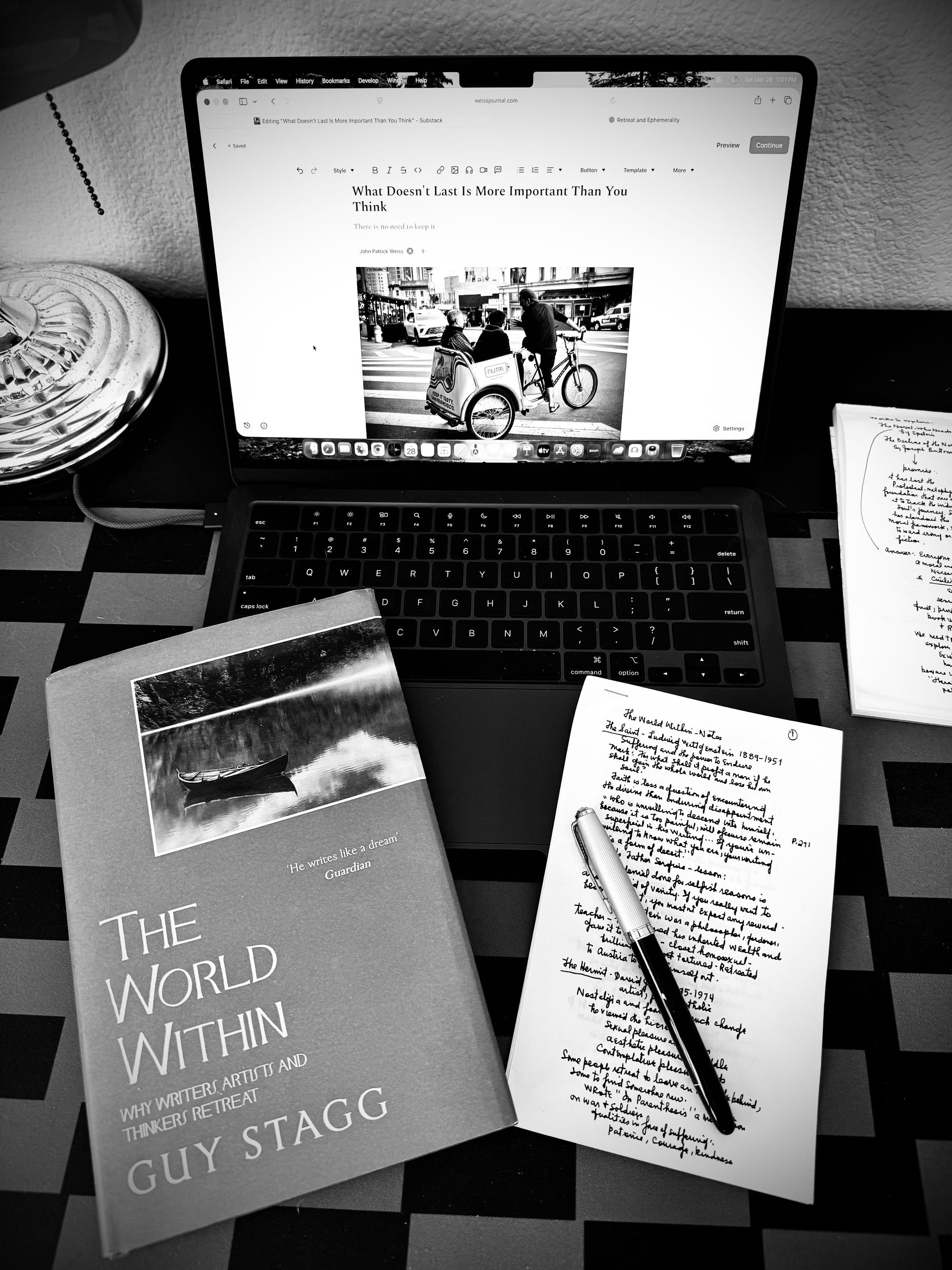
Some people possess a hunger that cannot be fed by company. Or they have wounds that deepen in the press of crowds. The only answer is retreat. To find a quiet refuge where silence can open a doorway to understanding, or a deer trail into a kind of spiritual clearing.
Wittgenstein’s refuge was a small cabin he built along the shore of Lake Eidsvatnet in Skjolden, Norway. It was his favorite place to think and write. Stagg describes it beautifully:
“Curtains of forest drawn across mountain slopes, the pine boughs textured like velvet. Inland fjords turning turquoise from their silted water, shading to deep green where the mountains were reflected. A wooden cabin balanced above a lake, like the ark cast ashore after the floodwaters receded.”
Wittgenstein came to the fjords five times in his life. He was often lonely there, but he kept returning. He needed the solitude. He believed that philosophical insight and moral improvement were linked. He needed this kind of retreat to know himself better, as reflected in his notebooks:
“Whoever is unwilling to descend into himself, because it is too painful, will of course remain superficial in his writing…If you are unwilling to know what you are, your writing is a form of deceit.”
Wittgenstein may have wanted to leave his life behind, but David Jones wanted to hide away.
Jones was a brilliant, hermit-like British modernist painter and poet who used solitude to process trauma. He suffered severe shell shock during World War I, particularly at the Somme and Passchendaele, before finding refuge at a Benedictine monastery on Caldey Island in the 1920s and 30s. In his final years, he lived as a recluse in a London bedsit, eventually dying in 1974 after time in a nursing home.
Jones seemed happiest on Caldey Island, where the quiet allowed him to paint. Even after he left, the island remained with him. He never married, never owned a home, and possessed very little.
Beyond the peace he found there, all he had left to retreat into was his art. It meant everything to him. Stagg recounts a visit from the composer Igor Stravinsky, who found Jones living in his cramped bedsit, his possessions kept close to the mattress like a wartime bunk. To Stravinsky, he looked like a hermit in his cell.
The walls were covered in paintings. When Stravinsky asked to buy one, Jones refused. After the visit, Stravinsky told a friend, “I have been in the presence of a holy man.”
And then there was Simone Weil, whom Stagg describes as a kind of martyr, someone who sought spiritual clarity through withdrawal and a deliberate embrace of suffering. During her time at the Abbey of Saint-Pierre de Solesmes, she developed the idea of attention as a form of prayer, a complete focus on reality and the suffering of others.
Weil believed the self could be reduced, not erased, but quieted, so that something truer might come through. It is not a fashionable idea. We are taught to become more, to assert and accumulate, to build a visible life. But Weil turned in the opposite direction, toward less.
There is a kind of relief in that. In the wisdom of less being more.
On a recent trip to San Francisco, I saw two men sitting side by side in the back of a pedicab, being carried through the city streets. The driver turned and told them they were welcome to take photos, just to be careful not to drop their phones. One of the men laughed and said they were not going to take pictures. They didn’t want the distraction. They just wanted to take it all in and experience it.
It struck me how rare that is.
We are taught to keep everything. To record it, store it, and build a life out of what can be retrieved later. But some things are not meant to last. Their purpose exists in the moment itself. And strangely, it is the essence of the moment that remains with us. Not as images we can revisit, but as something felt. Something carried.
Consider the artist Andy Goldsworthy, who makes his work from what he finds in the world. Leaves, stones, ice, branches. He builds something and leaves it where it is. The wind takes it, or the water carries it away, not unlike the sandcastles we built as children. The work is not meant to last. It is meant to be made, seen, and then returned.
This is not loss. It is the point.
The people Stagg writes about understood this. They sought retreat not because the world had nothing to offer, but because they wanted to meet it without so much of themselves in the way.
Most of us will not go that far. We will not enter monasteries or leave our lives behind. But there are smaller paths.
A walk without purpose. A quiet hour with nothing to show for it. A moment where you let something be enough without trying to keep it, photograph it, or hold it in place.
These are small acts, but they change something in you.
I return in my mind to that tree I used to sway in, and to those men in the pedicab moving through a city they chose not to capture. The tree will fall someday, just as I will. The streets will change. The moment will not return.
What remains is not the thing itself, but the fact that it was lived fully, without interruption.
It was enough. It did not last.
That is why it mattered.
Before you go
If these essays speak to you and you’d like to support the work, you can make a one-time gift below. I’m grateful for your interest and support.
Subscribe to Weiss Journal.
Visit my Noticings.
A solemn moment. Sometimes it feels as if you know me... all your descriptions of being in the woods (minus the deer, which we do not have in Belgium, where I lived) resound so fully, it is both almost spooky and on the other hand, so familiar. We just came in after walking almost an hour on the narrow paths I made years ago in my wooded acre... we heard the boys play volleyball and then we heard the 2 resident owls hoot and then bark. I saw a glimpse of one in the descending sunlight. Blessed weekend John, and thanks for the beautiful memories.
I had a tree like that. I would climb up (probably too far) and hide among the leaves. I felt as one with the birds, like we were connecting. I remember my devastation when that tree was cut down to make room for a garage. I was so sad. I never shared with my parents or family how I sought out these moments of isolation. But the feeling of the experience is as bright in my mind as if it was yesterday. Thank you for reminding me!