
To Endure Without Spectacle
Time does not pause out of courtesy

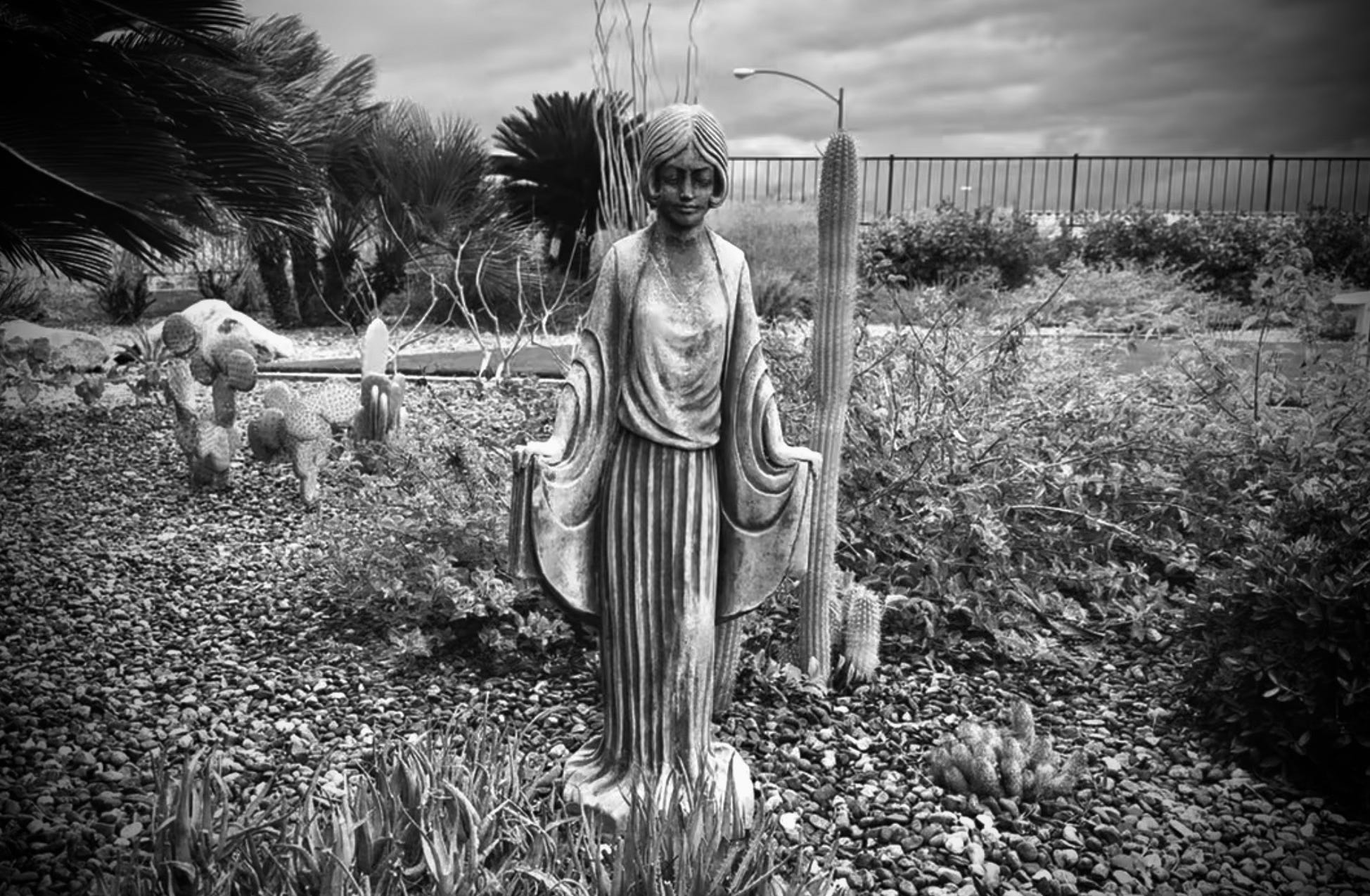
The statue stands in the yard without complaint.
Her name is Clarice. My wife and I adopted her years ago, drawn to the quiet, stoic serenity she carries with her.
Rain comes sideways.
Wind presses hard through the palms. The sky lowers itself into a single dark thought. Still she stands there, stone robes gathered in her hands, face calm, eyes cast downward as if she has already accepted what the day will bring.
She does not brace or resist, she simply remains.
I filmed her for a few seconds that afternoon. Nothing dramatic. No movement beyond what the storm provided. The camera held steady. The statue did the rest.
There was something mesmerizing in it, this idea of endurance without display, of stillness that does not ask to be admired.
Later that night my phone rang.
It was an old friend calling from a care facility. His voice was thinner than I remembered, worn down by age and illness and something harder to name.
He told me the television in his room didn’t work. He told me the nurses were curt. He told me he could no longer text because his eyesight had failed him. It was late on Christmas Eve, and the halls were already quiet in the way that makes a person feel set aside.
He had called others, I learned later. Many did not answer.
I turned the conversation toward photography. About the years when he carried a camera everywhere. How he documented events no one thought to remember. How he gave away prints like gifts without expecting anything back.
He laughed a little and for a moment the weight lifted. The past gently opened itself the way it sometimes does. I told him something I’ve come to believe, that memory can be a place you visit on purpose.
Close your eyes, I said. Go somewhere good. Call it up slowly. Let it take shape.
I told him about Carmel-by-the-Sea. About lying on an old green wool Army blanket my father brought with him wherever we traveled. About cold-cut sandwiches wrapped in wax paper. About glass bottles of Coke pulled from melting ice. About the sound of waves and the long pull of evening light.
He hummed softly to himself. We stayed there awhile.
Eventually he said his wife would be visiting soon. He said he was tired now. We said our goodbyes the way people do when neither is quite sure what the future holds. I told him I would call in a few days.
After we hung up, I went back outside.
The storm had not relented. Clarice still stood there, rain darkening the stone, wind threading its way through the garden. She did not look brave and she did not look afraid.
She looked resolved.
It occurs to me that growing old is not simply the loss of strength or speed or clarity of sight. It is the slow surrender of independence. The handing over of ordinary decisions. The reliance on strangers to be gentle when gentleness matters most.
Time does not pause out of courtesy. It does not slow for holidays. It keeps its pace, the same as it always has.
What remains, I think, is the manner in which we stand.
Not with clenched fists or speeches meant to impress, but with a quiet refusal to disappear. With memory, when memory is what we still possess. With kindness offered where it is still possible. With a phone call answered when others let it ring.
To stand. To remember.
We are on the cusp of a new year. For some, like my old friend, time grows thin and precious. For others, years and years remain to be shaped, misspent, redeemed, or carefully made into something that will one day sustain them.
Perhaps if we choose well now, if we pursue both grand adventures and small, ordinary moments worth remembering, we may stand a little firmer when the storms of aging arrive and when the long, echoing hallways of care facilities are all that remain.
To endure without spectacle.
And perhaps also to smile at those we love, to let them see a glint of appreciation in our eyes even when the body fails us or the spirit runs low. To offer gratitude when it costs something. To offer love even when we are tired and nearing the end of what we know.
These things matter more than we admit.
Gratitude and love go a long way in the late hours of a life. They sustain us, and they linger. They are contagious in the quietest way. They steady the people who remain after we are gone.
And so when the time comes, when we return to whatever it is we came from, perhaps something of us still stands. Not in grand monuments or remembered achievements, but in a simpler radiance. A warmth others feel without quite knowing why. Like a stone figure in a garden that has weathered many storms and still offers a sense of calm to those who pass by.
Something solid. Something upright.
Something that says, without speaking, that love was present here.
Before you go
This journal continues because a few readers quietly support it. If these pages matter to you, a small one-time gift below helps keep the work going.
Thank you for reading.
Subscribe to Weiss Journal.
Lovely. I hope that one day, when you are old - hopefully you won't need to a care facility in many many years - but when the time comes, I pray that someone might pick up the phone when you call. that someone might visit when you feel alone. that someone might be there when the tree of life gets old and britle.
Just dropping by to say that although I don’t comment very often, I still look forward to reading your weekly musings. Thank you for being a reliable and stable root system in a year prone to upheaval. All the best to you and yours in the new year.