
Letters of Hope

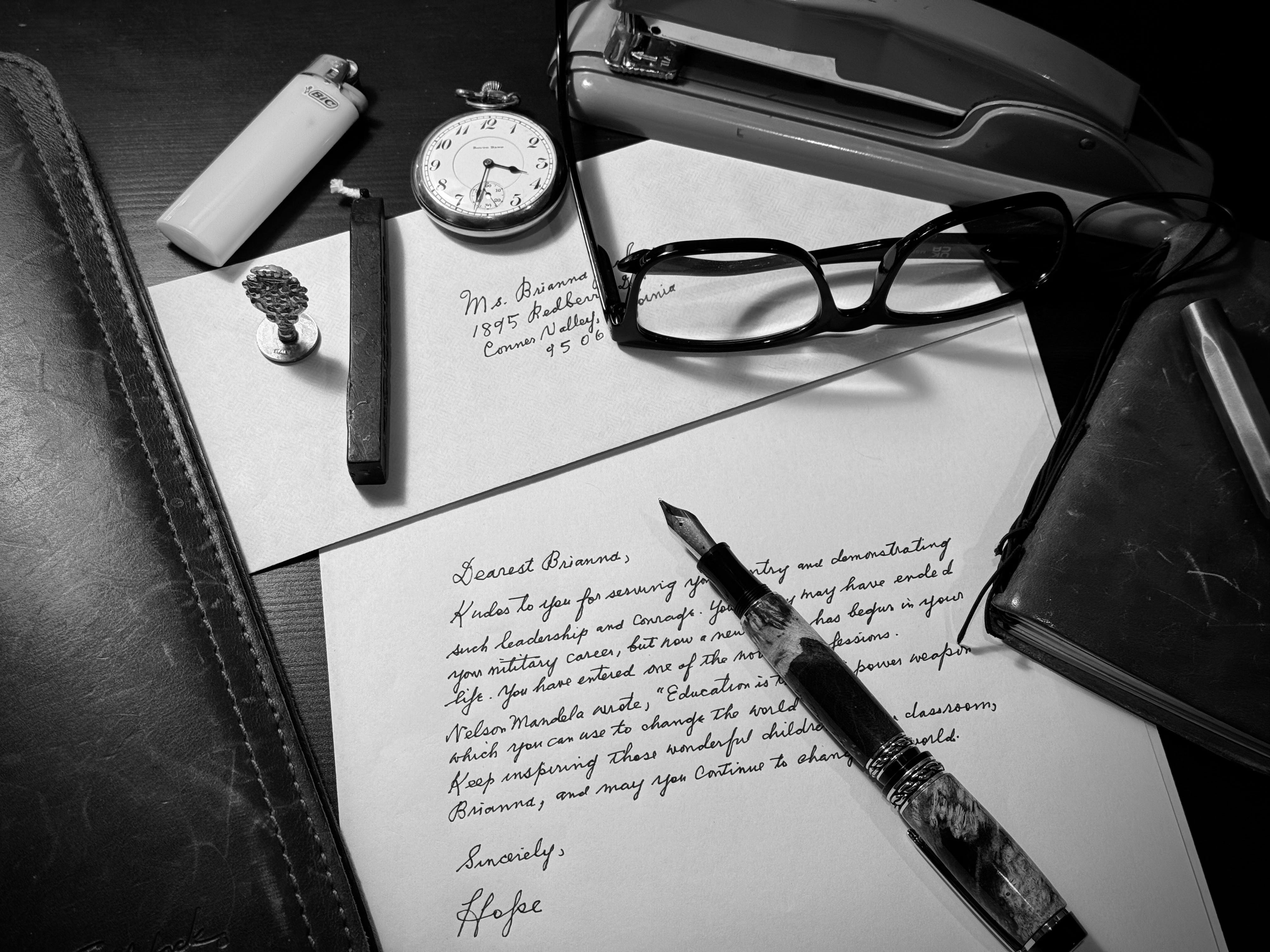
The first letter arrived in Rose Swanson’s mailbox two weeks after the death of her beloved husband, Vern.
Married for forty-one years, Vern and Rose were devoted to one another. They often walked around town holding hands. In today’s world of divorce and broken families, it was nice to see two people whose love thrived and deepened over the decades.
But then Vern experienced dizziness.
Tests and scans were taken, and Vern was told the bad news. An aggressive Glioblastoma Multiforme. Near the end, which came quickly, Rose held vigil beside Vern’s bed.
With a box of photographs on her lap, Rose reminisced and showed Vern images of their life together. The photos made Vern smile, but eventually, he fell into a coma. The following night, as Rose held Vern’s hands, his breathing slowed, and then he slipped away.
The funeral was well attended. In the days that followed, folks dropped off food and made sure Rose was doing okay. Rose put on a brave face and said she was holding up, but she wasn’t.
How can anyone be okay when the love of their life has departed, and the home they once shared becomes a vessel of memories and daily reminders of loss and loneliness? How can anyone carry on, when all you want to do is escape the pain and find a path back to the one you love?
Rose hid it well.
She told friends and acquaintances around town that she was adjusting, and that time heals all wounds. But she knew such words were only platitudes to appease others.
Platitudes to buy time, until she could summon the courage to finally do it. To finally end her life and begin the journey to Vern. She resolved to do it that weekend. She had it all figured out.
The car in her garage. A hose connected to the tailpipe. A painless end, and a pathway to wherever Vern had gone.
Sometimes, when people decide to end their lives, their mood improves. Relieved, perhaps, to finally have an escape plan from their emotional pain.
On Friday afternoon, Rose went to the mailbox at the edge of the driveway and bumped into her neighbor, Judy Bloom.
“Hello Rose, how are you doing?” Judy said with a smile.
“Pretty well, Judy. Finding my rhythm,” Rose said as she opened her mailbox and collected the bills and letters.
“It’s good to see you out and about. Let me know if you need anything,” Judy offered.
“Thank you, Judy, I appreciate that,” Rose said. As she strolled back to the house, Rose imagined Judy telling her friends the following week, “I can’t believe it, she seemed fine. I spoke to her Friday at the mailbox.”
Back in the house, Rose sat down in the living room and went through her mail. It was the usual bills and belated sympathy cards.
But then there was a cream-colored envelope addressed to her in exquisite handwriting. The envelope had no return address, and the back contained a red wax seal with the stamped letter “H.”
“I wonder what this could be?” she said.
Rose carefully opened the back of the envelope and pulled out the neatly folded stationery. She unfolded the paper and was struck by the immaculate penmanship.
She read the following:
Dear Rose,
Your beloved husband Vern’s obituary ran in the local paper recently, and the accompanying photograph reminded me of a pleasant encounter with him a few years ago.
We both arrived at the barbershop and he held the door for me, with a smile and the words, “After you, dear Sir.”
What a kind and thoughtful man.
Inside, I overheard Vern’s conversation with one of the barbers. The barber asked him what he loved best about retirement, and Vern said, “I get to spend every day with my wife.”
You brought Vern such joy.
And now, I imagine, you are lost in an ocean of grief and uncertainty about the future. This is not unusual, especially when two people have been married as long as you have.
Queen Elizabeth II said, “Grief is the price we pay for love.”
Some say that grief lasts forever. But then, the impressionist painter Renoir said, “The pain passes but the beauty remains.” Helen Keller noted, “What we have once enjoyed deeply we can never lose. All that we love deeply becomes a part of us.”
The best way to honor the ones we have loved and lost is to continue living our lives fully and completely.
When we dive back into our passions, help others, and continue to grow in our hearts and minds, we send a kind of ethereal love letter. It travels far beyond the shores of this world to our lost loved ones. And when received, it fills our loved ones’ souls with eternal joy and peace. Because they know that we’re going to be okay.
Send Vern that love letter, Rose.
Tell him about your gardening and the good work you’re doing with your church. Show him that you’re bigger than death. That you can continue loving and honoring him by living your best life.
I know you can do this, Rose, and I sense that Vern will be cheering you on.
Sincerely yours,
Hope
The letter nearly took Rose’s breath away, as tears flowed down her cheeks. She had no idea who Hope was, or how Hope seemed to know so much about Vern and herself.
But it didn’t matter, because the letter awakened something inside Rose. For the first time since Vern’s death, Rose felt like she could breathe a little. Grief’s vise grip on her heart loosened. She sensed the truth of the letter, that Vern would want her to live on.
For the first time since Vern’s funeral, Rose felt like maybe she could craft a meaningful future. She could honor Vern by helping others and finding her best self.
For the first time, Rose felt hope.
Stanley Carlson had never been to jail before.
There were other low points in Stanley’s life like the day his wife left him and filed for divorce. Or the day his boss fired him because Stanley was late to work again and “increasingly unproductive.”
But then, Stanley was a survivor.
He wasn’t about to let his ex-wife or unforgiving boss ruin his life. He was going to show them all. He found a new job and celebrated. He bought everyone at the bar a round. He even got the phone number of the blonde woman sitting next to him.
It had been a fantastic night until he noticed the emergency lights in his rearview mirror.
The officer was efficient, professional, and quickly noticed Stanley’s glassy eyes and slurred speech. She ordered Stanley out of his car and put him through various field sobriety tests.
He failed them all and ended up in a pair of handcuffs.
The back of the patrol car was uncomfortable. “Why are your backseats made of plexiglass? They’re totally uncomfortable,” Stanley complained to the officer. “It’s harder to clean puke out of cloth seats,” the officer said.
They parked in an enclosed sally port at the rear of the jail, and the officer led Stanley out of the car and to the jail’s locked security doors. She pressed a button, and after a moment, there was a buzzing sound, and the door unlocked.
They entered a hallway, where two uniformed jail staff met them.
“Drunk driver, mostly cooperative,” the officer said to the jail personnel as she handed them paperwork.
The jail staff patted Stanley down. They removed his wallet, keys, an empty flask in his left pocket, his belt, and shoes. They told Stanley that all his possessions would be recorded and returned to him upon release.
It was noisy.
There were loud voices, the clanking of doors, buzzers, loudspeakers, and people yelling in holding cells.
And the smell.
The drunk tank they put Stanley in held five other inebriated souls. Two were passed out, and the others were mumbling to themselves. It smelled like a stale brewery mixed with vomit and body odor.
Stanley sunk against the wall in the corner. He held his face in his hands and wept for the marriage he once had. He wept for the jobs he had lost. He wept for the little boy he once was, who dreamed of great things.
He wept for the better man he had failed to become.
When Stanley was sober, they released him from jail. His things were returned to him, and he was given a court date for his DUI offense. He arranged an Uber ride home since his car had been towed and impounded.
Back home, Stanley swallowed several Advil and drank lots of water to assuage his hangover. He sunk into bed and slept all day.
When he awoke he found several messages from his new boss, asking where he was. Great, he thought, I’m going to lose another job. Why does this keep happening? But then, he knew the answer.
And for the first time in his life, he said the words, “I’m an alcoholic.”
Stanley denied this all his adult life, until now. Stanley’s father was a binge-drinking alcoholic, so it seemed to run in the family. And life did not end well for Stanley’s father. He developed liver cirrhosis that led to an early death.
“Ah Dad, I’m so sorry. Looks like your son followed in your footsteps,” Stanley said. And then he sank into his living room chair, waiting for the Advil to ease the pounding in his head, and he dozed off.
His father came to him in a dream.
Stanley’s father may have struggled with alcoholism, but he was a gentle man who loved his family and son. Yet he carried demons in him from the Vietnam War, and alcohol was the only tool he knew to cope. But in this dream, Stanley’s father was sober, and he whispered in Stanley’s ears, “Son, you can change. Be the man I wasn’t able to be.”
And this is how it began, thanks to one dream in the throes of a hangover.
Stanley showed up the next day at his first Alcoholics Anonymous meeting. He was nervous and felt strange sitting in that old church conference room amidst an eclectic mix of locals. He was surprised at some of the people there. For example, the president of the local bank. And a dentist he recognized. But then, alcoholism doesn’t discriminate. It affects people of all genders, races, and socioeconomic backgrounds.
Everyone was encouraging, and the dentist ended up being his sponsor.
“Call me anytime, Stanley. We’ve all been through what you’re going through. You can do this,” the dentist said.
Stanley threw out all the booze in his house. He joined the local health club. He sat down with his new boss and told her everything. About his drinking problem. The DUI arrest. And the meetings he was attending. Much to his surprise, his boss didn’t fire him. Turns out she was in recovery, too. Twelve years sober, she said.
The letter arrived one month into Stanley’s recovery.
He came home one afternoon from the gym and checked his mailbox. Among the bills and junk mail sat an elegant, cream-colored envelope, bearing Stanley’s name and address in exquisite penmanship. On the back of the envelope, a red wax seal was affixed, with the letter H stamped in the middle.
“What the heck is this?” Stanley asked himself as he sat in his kitchen and tore into the envelope. He slipped on his reading glasses, and read the letter.
Dear Stanley,
We don’t know one another and I hope you’ll forgive my forwardness in sending this note. I have been a writer all my life, which means I have also been a close observer of people, places, and things. I see the comings and goings of people, especially in this little town we live in.
My mother struggled with alcoholism her entire life.
I loved her dearly, and I always prayed that she would find a path to recovery. Sadly, she never did, and I mourn the better life she could have had.
The late author and poet Charles Bukowski, crude as he could be sometimes, was a keen observer of people. Especially people on the margins of society. An alcoholic, he spent much time with prostitutes and drinking in bars, so he deeply understood how souls can lose their way.
Bukowski wrote the following:
“I was drawn to all the wrong things: I liked to drink, I was lazy, I didn’t have a god, politics, ideas, ideals. I was settled into nothingness; a kind of non-being, and I accepted it. I didn’t make for an interesting person. I didn’t want to be interesting, it was too hard. What I really wanted was only a soft, hazy space to live in, and to be left alone. On the other hand, when I got drunk I screamed, went crazy, and got all out of hand. One kind of behavior didn’t fit the other. I didn’t care.”
When we stop caring, something inside us dies.
To your great credit, you decided to care. So did the late author Caroline Knapp, whose book, “Drinking: A Love Story,” I recommend.
Here’s a snippet from the book:
“When you quit drinking you stop waiting.”
I love that line because of its truth. When you quit drinking, you stop waiting for the other shoe to drop. You stop waiting for five o’clock when you can escape work and get a drink. You stop waiting for the hangover to recede. You stop waiting for the cop behind you to drive past. You stop waiting for your spouse to find the hidden bottle.
In short, you stop waiting for your better self to come out of the shadows. When you quit drinking, hard as it can be, you suddenly find the promised life. A better life. A sober life. You sleep better. You feel better. You remember more.
The wait is over, Stanley. Welcome to your new life.
Sincerely yours,
Hope
Stanley was so moved by this letter from a stranger that he shared it with everyone at AA. He asked, “Does anyone know someone in town named Hope? Is she involved with AA?”
But no one knew who Hope was.
“Maybe she’s an angel?” someone in the group said.
“Yeah, maybe she is. Because man, the letter just blew me away. It uplifted me, you know?” Stanley said.
Everyone nodded in agreement.
The mysterious letters showed up all over town.
Tommy Johnson’s dog, Duke, was struck and killed by a car, and a few days later, Tommy received a cream-colored envelope in the mail with that same immaculate cursive and the encouraging words:
When our beloved animal companions leave us, they go to a place where they live forever. It’s a peaceful place where all their needs are met, they are free, and they can visit us in our dreams and memories. To remind us how much we are loved and that everything will be okay. And one way we can honor their lives when the time is right is to adopt a new furry friend. Because every time we rescue an animal in need, we bring joy to all the animal companions we loved and lost.
When Army Sergeant Brianna Jackson returned to town after a training accident that ended her military career, she decided to study and take the state exam to become a grade school teacher. She wanted to begin a new career in education and inspire young minds.
After she was certified and began her new position as a third-grade teacher at Fairmont Elementary School, a mysterious letter arrived in her mailbox. The copperplate penmanship beautifully expressed the following words:
Dearest Brianna,
Kudos to you for serving your country and demonstrating such leadership and courage. Your injury may have ended your military career, but now a new chapter has begun in your life. You have entered one of the noblest professions.
Nelson Mandela wrote, “Education is the most powerful weapon which you can use to change the world.”
Keep inspiring those wonderful children in your classroom, Brianna, and may you continue to change the world.
Sincerely,
Hope
The town’s newspaper published an article about the letters, followed by a story in the local television news.
Opinions varied.
Some felt that the letter writer was creepy like a voyeur spying on folks and then sending letters about their lives. But most people in town thought the letters were benevolent and beautiful.
As one local said to the news reporter, “Don’t you think, with all the bad things going on in the world, we deserve a little encouragement and love? Imagine if we all started writing each other letters like that?”
And so that’s the way it was for some time.
The letters kept coming to those who seemed to need them the most. And always with words of encouragement and hope. Some felt the letter writer’s name wasn’t Hope, but rather a pseudonym that captured the purpose of the letters.
A few town sleuths tried to figure out who the letter writer was. “Probably an old person, because young people don’t know how to write cursive like that,” one local said. According to a few postal workers, the letters were dropped off in various outgoing mail slots around town, so no one knew who the author was.
And then one day, a few years later, the letters stopped coming.
“Mayor Carlson, I have a phone call for you on line one. It’s Dan Miller, the producer at the local news station,” Wendy, the mayor’s executive assistant, said over the phone intercom.
“What’s it regarding?” Mayor Carlson asked.
“They found out who the letter writer was,” Wendy said.
“Put him through.”
“Hi, Dan. Wendy tells me you know who the mysterious letter writer is?” Mayor Carlson said.
“Well, Mayor, we know who he was. I’m afraid he passed away last week. We might never have known, but one of his caretakers stumbled on some things while she was looking for his DNR order,” Dan said.
“His DNR order?” Mayor Carlson said.
“Yeah, a ‘Do Not Resuscitate’ order. A lot of older residents at the assisted living center have them. That way, if they have a stroke or heart attack, the emergency responders don’t have to take life-saving measures. I mean, when you are old and infirmed, sometimes death is a welcome reprieve from suffering,” Dan said.
“Yeah, I get it. So what did the caretaker find?”
“She found a wooden box in his closet full of cream-colored stationery, several fountain pens, ink bottles, red sealing wax, a lighter, and a stamp with the letter H on it. And there were some unfinished letters, too. All written in that beautiful, elegant cursive we’ve seen in the letters around town. Anyway, we’re doing a story on it at 5 o’clock, and we wanted to give you a heads-up. And we’re sending a reporter and cameraman over to get a statement from you if you don’t mind. After all, you were one of the lucky people who received a letter from him.”
“I appreciate the heads up, Dan. And sure, I’m happy to talk to your reporter. But I’m curious, who was he? Why did he send out all those letters? How did he know about so many people in town?”
“Well, turns out he was a retired literature professor. He used to teach at the university. He lost his wife to cancer years ago. His caretakers said he never quite got over her death. For a lot of years, he was mobile and used to take the bus all over town. And I guess he was adept online, and followed the local news and even social media closely. I think that’s how he learned so much about folks here in town.”
“I wonder why he stopped writing his letters?” Mayor Carlson asked.
“He had a stroke and was no longer able to write. He did leave behind a diary, and one of the caretakers peeked at it, even though she wasn’t supposed to. Apparently, he started writing all those letters to honor the memory of his wife, who he wrote was a Saint on Earth. And she was. She used to work at the county orphanage and volunteered on weekends at the animal shelter. Really, they were quite a couple,” Dan said.
“Wow, I’ll say. Okay, Dan, send over your reporter, and thanks again for the heads up,” Mayor Carlson said.
Rose Swanson and her neighbor Judy Bloom enjoyed tea at Rose’s house that afternoon. They had become close friends over the years, ever since Rose received that mysterious, beautiful letter and shared it with Judy the next day, crying together.
They enjoyed gardening and often sold the squash they grew at the local weekend farmer’s market.
“Hey, can you switch on the 5 o’clock news, Rose, I want to see if it’s going to rain tomorrow,” Judy said.
Rose clicked on her television, and the two sat back on the couch to watch the news. A handsome young anchor opened the broadcast with the following:
“I’m Phil Carter, and this is your five o’clock news. Now, our lead story. For years, locals received mysterious, beautifully handwritten letters in the mail. Letters of encouragement, wisdom, and advice. And they were always signed, ‘Sincerely yours, Hope.’”
Rose and Judy looked silently at one another and leaned forward to watch the rest.
The anchor continued:
“His name was Professor Theodore H. Flannery. He taught English literature for many years at the county university. A few years after he retired, Professor Flannery’s wife, Helen, known locally for her work at the orphanage and animal rescue, passed away. The couple had no children, so Professor Flannery spent the years reading, walking about town, and writing. We take you now to the university, where our reporter, Juan Sanchez, spoke with one of Professor Flannery’s colleagues, Professor Emeritus of Biology, Eleanor Foster.”
“This is unbelievable,” Rose said. “I can’t believe I was one of the people who received one of his letters.”
The news segment cut to reporter Juan Sanchez, standing next to Professor Eleanor Foster on an expansive front lawn of the university.
“Professor Foster, what can you tell us about Professor Flannery?”
“He was a wonderful, kind, gentle man. Devoted to his wife and his students. He was an amazing literature professor. But you know, he did have a touch of sadness in his eyes. He wanted to become a novelist and inspire people with words, but somehow his manuscripts never found a willing publisher. That happens, you know. Sometimes we’re better teaching a subject,” Professor Foster said.
“Why do you think he wrote all those letters to total strangers?” Juan Sanchez asked, holding the microphone up for Professor Foster.
“I think he wanted to honor his wife’s memory. Helen was such a splendid woman. A true humanitarian. She believed the highest calling we can have is to help others and improve the world around us. So I think Teddy, that’s what his colleagues called him… Teddy wanted to follow his wife’s lead and use his writing ability to help inspire others. In a way, his letters are better than a novel. They’re his magnum opus. His love letters to humanity,” Professor Foster said.
“Love letters to humanity. Well said, Professor. Thank you. Back to you in the studio, Phil.”
Rose and Judy weren’t the only ones watching the five o’clock news. A few miles away, Tommy Johnson and his rescue dog Skip had the news on.
“Mom, come quick,” Tommy yelled.
“What is it?” his mother said.
“You won’t believe it. Remember the letter I got after Duke died? Well, they figured out who wrote the letter. He was a retired English professor. And get this, his wife used to work at the animal rescue where I adopted Skip after Duke died.”
“That’s amazing,” Tommy’s mother said, as she sat down to join him and watch. The news anchor, Phil Carter, said, “Thanks again, Juan. Let’s go now to reporter Elizabeth Traynor at City Hall.”
“Thanks, Phil, I’m here at City Hall with Mayor Stanley Carlson. Mayor Carlson, you were one of the people who received a letter a few years ago from our mystery letter writer, Professor Flannery. Your reaction?”
“Well, Elizabeth, all I can say is that Professor Flannery’s letter changed my life. Back then I was down on my luck. I was divorced. I had a drinking problem. As most people know from my opponent’s smear campaign during the mayoral election, I was arrested for DUI. After I started attending AA meetings and cleaning up my act, that mysterious letter arrived. I keep it framed in my office.”
“That’s amazing,” the reporter said.
“Yeah, I’ll never forget one line in the letter. He wrote, ‘When we stop caring, something inside us dies.’ And I decided right then and there that I did care. I cared about my life. About becoming a better person. So I got sober. I volunteered. I got into local politics. And, well, here I am today. But the weird thing is that I always thought the letter writer was a woman because it was signed ‘Hope,’” Mayor Carlson said.
“Well, Mayor, our sources tell us that the Professor’s middle name was Hope. According to a University associate of his, Professor Flannery’s late mother struggled with alcoholism. She gave her son the middle name of Hope because he seemed to radiate a kind of loving grace. A kind of hopefulness,” the reporter said.
“Well, his mother’s instincts were spot on. Because Professor Flannery gave hope to so many of us in this town. Hope to overcome our struggles and live better lives,” Mayor Carlson said.
“Thank you, Mayor Carlson. Back to you, Phil.”
“Thanks, Elizabeth,” Phil Carter said, adding, “And thank you, Dr. Theodore Hope Flannery. You may not have realized your dream of becoming a novelist, but your letters gave hope to many in this small town, and your legacy will never be forgotten.”
The station cut to a commercial break.
Another person watching the 5 o’clock news that afternoon was Brianna Foley, who excitedly called out to her husband, Draymond.
“Draymond, you won’t believe it!” she yelled.
Draymond came into the room. “What is it? Is everything alright?”
“Yes! Remember that letter I showed you years ago? After I got discharged from the army because of my injury. Before we got married, when I was just starting my teaching career,” Brianna said.
“Yeah, someone named Hope sent you a handwritten letter of encouragement.”
“Exactly. Well, it was from a retired literature professor named Theodore H. Flannery. And his middle name was Hope. After his wife died, he wanted to honor her kindness and legacy by encouraging others. How cool is that?” Brianna said.
“You know, that name sounds familiar. I’ve heard it before. At work, I think,” Draymond said.
“You work in a publishing house in the city, miles from here. Why would his name be familiar?” Brianna asked.
“I don’t know. Let me call Jill in the office. I know I heard that name recently, and Jill has the memory of an elephant,” Draymond said.
He phoned Jill, the senior editor at the publishing house, and told her the entire story about Dr. Theodore Hope Flannery and that he remembered hearing the name somewhere.
“That’s because I mentioned him two weeks ago, Draymond. Don’t you remember? We found a few of his old manuscript submissions in the backroom slush pile closet. Remember, Douglas discovered them, and he thought the writing was pretty good.
“Good Lord, you’re right, I remember now. Brianna won’t believe the coincidence. It’s all pretty remarkable. This guy touched a lot of lives with his letters.
“Hey, I have a crazy idea,” Jill said. “What if we were able to collect all the letters he wrote? You know, put out press releases and invite people to send us copies of his letters. It would make an amazing book.”
“You know what, Jill, you might be on to something. Let’s float the idea with Douglas at tomorrow’s staff meeting.”
Douglas was the new head editor at Little House Publishing, a mid-level publishing house with several best-selling titles already under their belt.
Douglas had a discerning eye for great literature, but he also understood the publishing world and how unique and uplifting titles can sometimes catapult to best-seller status.
When Draymond and Jill floated their idea about Dr. Theodore Hope Flannery’s collected letters, something stirred in him. Call it an intuition, a spiritual vibration.
“I like it. I like it a lot. Okay, let’s explore how we can collect copies of all those letters,” Douglas said in the staff meeting, adding, “We’ll have to get legal involved to obtain permissions and sign-offs. And once we comb through all the letters, we’ll need a book title for the collection. Something concise that captures the impact and essence of his letters.”
“How about ‘Letters of Hope?’” Draymond volunteered.
Everyone in the room grew quiet.
It was the kind of moment when something profound was happening. And something profound was happening. The kindness, love, and legacy of an old literature professor swirled around in that publishing house conference room. Dr. Theodore Hope Flannery’s spirit was with them. Everyone could feel it and loved Draymond’s suggestion for the book’s title.
It took a little over a year.
Nearly all the letters were collected, except one lost to a house fire and another buried with its owner. Douglas told the publishing staff he’d give a raise to anyone who could convince the family to sign off on an exhumation order, but he was only joking.
The book was titled “Letters of Hope” with the subtitle, “A Literature Professor’s Gift to Those in Need.”
News of the book and its story spread far and wide, catapulting it to The New York Times Best Seller status. Suddenly, Little House Publishing grew in stature, and many fine authors and writers began working with Douglas and his expanding staff.
Dr. Theodore Hope Flannery had left behind a modest living trust. Any proceeds from the sale of his assets were to go to the local orphanage and animal rescue where his beloved wife had worked for so many years.
Dr. Flannery posthumously achieved what he always dreamed of when he was alive. He had become a successful, published author, and through the proceeds from his book sales, the local orphanage and animal shelter received a windfall of much-needed, recurring income.
Dr. Flannery’s late wife Helen would have been so proud, just as everyone in the community was proud of Dr. Flannery. Through his elegant, cream-colored stationery and fountain pens, he inspired everyday people through his letters to live better lives.
Lives filled with hope.
Sometimes, at dusk in town, locals swore they saw an old couple walking hand in hand down the street beside the duck pond. Other times, volunteers at the animal shelter reported seeing an old couple walking the dogs around the facility, but they’d always disappear.
Mayor Carlson had a similar experience.
He’d been invited to visit the local orphanage and read to the children for their “literature week” program. Mayor Carlson brought his copy of Dr. Flannery’s book to read a few of the moving letters.
The children were all assembled in the orphanage’s library, and Mayor Carlson opened the book and read the letter he’d personally received, along with a few others. And he told the kids to never give up in life. That anything is possible.
After the reading, on the way to his car, Mayor Carlson thought he heard a twig break in the distance. When he looked up, he saw what appeared to be an old couple standing by a tree, and the man waved to Mayor Carlson.
Mayor Carlson waved back and said, “Thank you, Dr. Flannery. Thank you for saving my life. God bless you and Helen.”
Mayor Carlson stepped forward to get a better look, but lost his footing on a mound of grass, dropping his copy of Dr. Flannery’s book.
He reached down, picked up the book, and looked back at the tree.
But the old couple were gone.
(Originally published in "The Morning Fox," 2024)
Before you go
This journal continues because a few readers quietly support it. If these pages matter to you, a small one-time gift below helps keep the work going. Thank you for reading.
Subscribe to Weiss Journal.

I'm so glad I took a few moments to read this article. It's sticking with me like a new memory of a wonderful experience. The article was like having a spa day at a place where they rejuvenate your soul.