
Everyone Is Carrying Something
The beauty of composed serenity

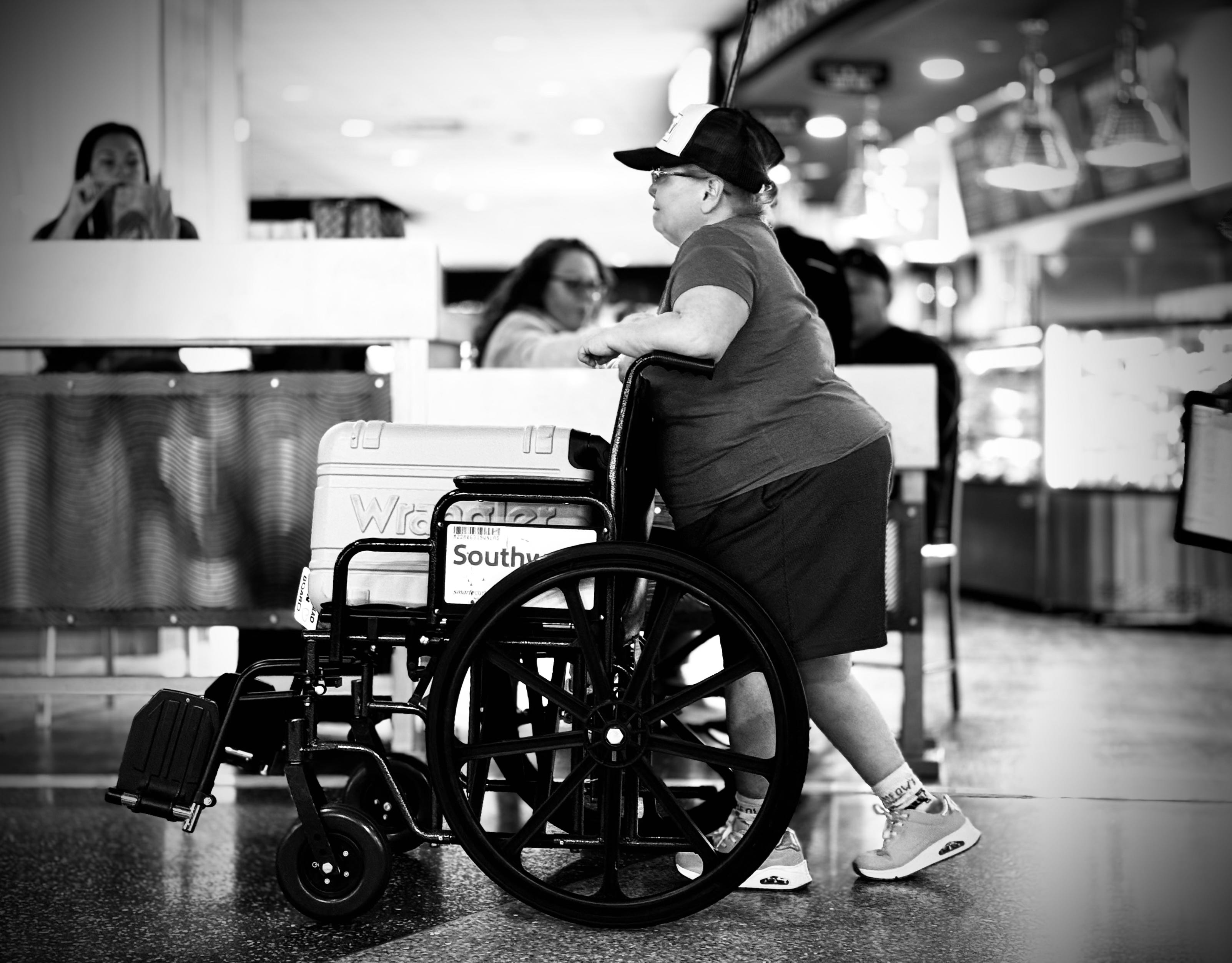
I was waiting in the airport for my flight home when I noticed her.
She was a small woman pushing a wheelchair that held luggage. The chair looked oversized against her frame, and she leaned against the handles as if nursing a bad back or relieving some invisible pain.
She appeared to be alone.
I watched as she paced slowly about the terminal in a meandering pattern. She did not seem to have a destination in mind. I assumed she was passing time while waiting for a flight, or perhaps walking to loosen stiff muscles.
Airports are full of movement. People hurry through the corridors dragging suitcases behind them or staring into their phones while the loudspeaker announces departing flights. The whole place becomes a blur of peripatetic humanity.
Yet this diminutive woman moved differently through the terminal. Something beyond her small stature caught my attention. She seemed slightly adrift, or perhaps searching for something beyond her travels. There is an expression sometimes found in the faces of unsettled souls, and she carried it quietly.
A kind of stoic resignation.
Watching her, I began to wonder about her life.
Moments like that invite reflection. When you see someone moving through the world in such a solitary way, you begin to imagine the roads they must have traveled before arriving in a crowded airport filled with harried travelers, busy airline employees, and indifferent vendors. You wonder what their earlier years might have been like, especially those fragile school days when hormones rage and children can be cruel.
As I watched her move slowly through the terminal, an old memory surfaced.
There was a boy at the small private school I attended in the 1970s. His name was Skipper.
Skipper had a physical disability and was tiny compared to the other kids. He was stooped over, walked with difficulty, and his arms had limited motion. His voice carried a strange gravelly pitch that made him sound like an old sailor.
During our lunch breaks the owner and principal of the school, Ralph Denman, played softball with us. Denman always pitched. Whenever Skipper came to bat, Denman would subtly adjust the speed of his throw so the ball arrived slowly enough to give Skipper a fighting chance.
Many times Skipper swung and managed to connect. The ball would dribble five or six feet toward the pitcher’s mound, where Denman often took his time bending down to pick it up. By the time he straightened and threw to first base, Skipper was already halfway down the line.
Denman was a Navy veteran with a gruff exterior, but we all recognized his softer side.
Sometimes Skipper made it safely. Other times he was tagged out. But he never complained and never sought pity. He played as best he could, and in doing so he won our hearts. We admired his quiet determination in the face of adversity.
It is funny how a small woman in an airport, decades later, can call up those old memories of Skipper. Yet what I felt while watching her was much the same feeling I had about him all those years ago.
Everyone is carrying something.
A wound, perhaps. Regret. Disability. Sorrow. Pain. Despair.
And maybe hope as well.
Standing there in the airport, these thoughts moved through my mind as I watched the woman lean into the wheelchair and continue her slow circuit around the terminal. Her luggage rested easily on the chair, but I could not help wondering about the weight of the burdens people carry inside themselves.
Does that weight slow them down, or strengthen their resolve?
A quote by Elisabeth Kübler-Ross came to mind:
“The most beautiful people we have known are those who have known defeat, known suffering, known struggle, known loss, and have found their way out of the depths. These persons have an appreciation, a sensitivity, and an understanding of life that fills them with compassion, gentleness, and a deep loving concern. Beautiful people do not just happen.”
Skipper was beautiful, and so was the woman in the airport.
Their beauty is not the kind displayed on the covers of fashion magazines. It is deeper than that. It is the beauty of composed serenity, the quiet dignity of people who move through the world carrying their burdens without bitterness.
Their strength reminds me of the Japanese art of Kintsugi, where broken pottery is repaired with gold lacquer. The fractures are not hidden. They are illuminated. Broken pieces are joined together in a way that creates something stronger and more beautiful than before.
But we will never see that beauty if we do not take the time to notice.
I watched the small woman lean into the wheelchair and continue her slow circuit through the terminal. The great black wheel rolled beside her like a quiet companion.
People hurried past and flights were announced, but she kept moving through the terminal, leaning into the chair as she made her slow circuit across the floor.
Carrying something, like we all do.
Before you go
This journal continues because a few readers quietly support it. If these pages matter to you, a small one-time gift below helps keep the work going. Thank you for reading.
Subscribe to Weiss Journal.
Visit my Noticings.
Inspiring as always! Thank you!!!
Funny how something unrelated can wake up our filing cabinets inside our heads! Yesterday I saw the obituary from a former neighbour back in Belgium, and all of a sudden loads of memories came floating.. yes we all carry suitcases of luggage, but thankfully, we have a choice and can pick out the nice ones, while putting aside the painful ones. Just like you did with Skipper. Instead of concentrating on the disabled boy, you saw the teacher gently adjust to give the child a chance. Thankfully there still are teachers able to do this - and people like you who report on the good side of life, while there is so much horror going on. thank you.