
A Man Who Has Outlived His Era
Posts change, the watch remains

Lately I’ve begun to feel like a man who has outlived his era.
It took a while to come to this conclusion. For a long time I couldn’t quite put my finger on it, until clues began to accumulate.
Like the melancholy I feel whenever visiting the town that held my law enforcement career for twenty-six years. Something about it feels distant and foreign now.
And the tyranny of technology, with its infernal apps and notifications and sign-ins. Also the coarsening of society, where people forego conversation to exist inside blinking screens of digital distraction, algorithms, and noise.
It’s harder to phone people now.
It seems folks prefer a text, that layer of digital insulation through which one must probe for availability. If you break convention and phone directly, the call lands in voicemail where the message can be prioritized and inspected before committing to a response. And if it’s too much trouble to call back, just text a curt reply.
Go into a bank with questions and the skeleton crew will smile and suggest you check your bank app.
“You know you don’t need to come in, you can do that on your app,” one will say.
The grocery store is down to one or two human cashiers. That’s where the old folks line up, those lonely souls longing for human interaction to break the monotony of the day. Everyone else scans their items at the self-checkout rows. In and out. No need to talk to anyone, except when you can’t figure out how to enter produce or need an employee to approve your alcohol purchase.
Visit San Francisco and the streets are flowing with Waymo driverless taxi cabs. It’s all computerized. No need to speak to anyone. You can scroll cat videos on TikTok while your robot cab drives you across town.
This is modernity.
It’s nothing new. Technology evolves. Advancements happen. To the young, this is the world they know. To older generations, it’s the world they must adapt to. And for some, there comes a time when it all feels alien and unfriendly and frightening.
I think the fear comes from a sense of existential loneliness. A feeling that one has outlived one’s era.
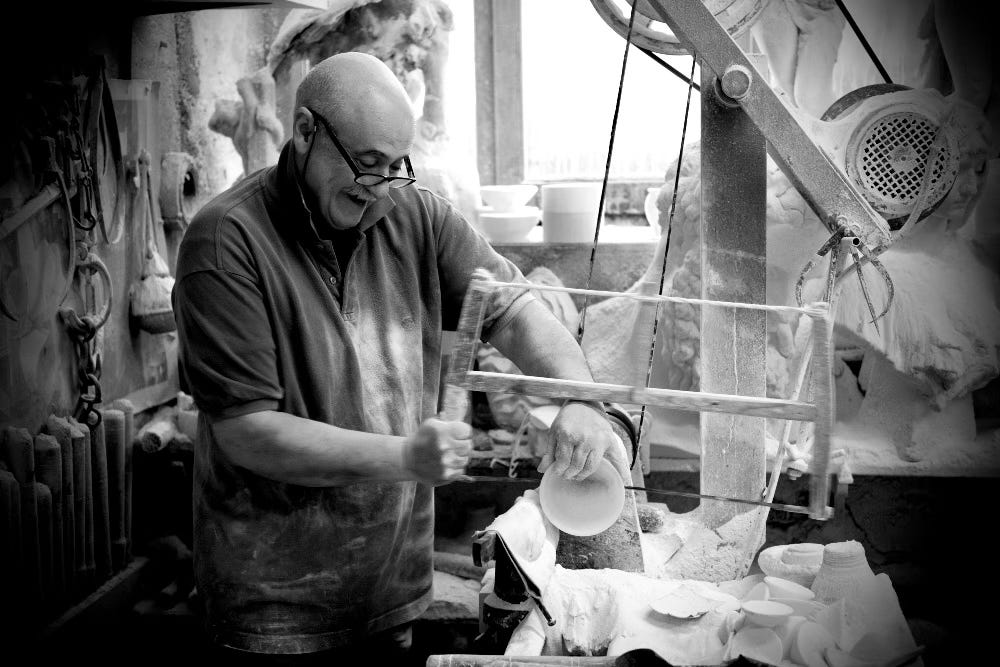
Sometimes I envy the alabaster sculptor I met in Volterra, Italy.
My wife and I were part of a small tour group. Our guides arranged a private visit to the sculptor’s shop and studio, which was filled with stunning works of art. The back studio and equipment were covered in a fine film of powdered alabaster dust. The artist, smiling and happily engrossed in his work, sculpted a perfectly shaped bowl for us.
What struck me was his countenance.
He never stopped smiling. An inner radiance illuminated his presence. He was surrounded by tourists with smartphones and digital cameras, snapping photos and filming. Everyone was chattering. But the sculptor was blissfully immersed in his artisanal craft.
Volterra is a walled hilltop town, a human settlement dating back to the 8th century BC. It was a major Etruscan city-state. And it was the Etruscans, in the 3rd century BC, who discovered that the locally available “chalky” alabaster was much easier to carve than marble.
No wonder the sculptor was smiling.
He was part of an ancient craft. An artist still sculpting alabaster just as they did thousands of years ago. His joy came from the pleasure of working with his hands and making works of art that still held relevance and value in this age of glowing screens and digital artifice.
The sculptor was a man in the modern world who had found a way not to outlive his era.
Last year I read Denis Johnson’s poignant and beautifully written novella Train Dreams.
Train Dreams tells the story of Robert Grainier, a day laborer in the early-20th-century American West who works on railroad and logging crews in the Pacific Northwest. The novella follows his quiet life marked by brief love, devastating loss, and long stretches of solitude, reflecting on memory, grief, and the fading of the old frontier world.
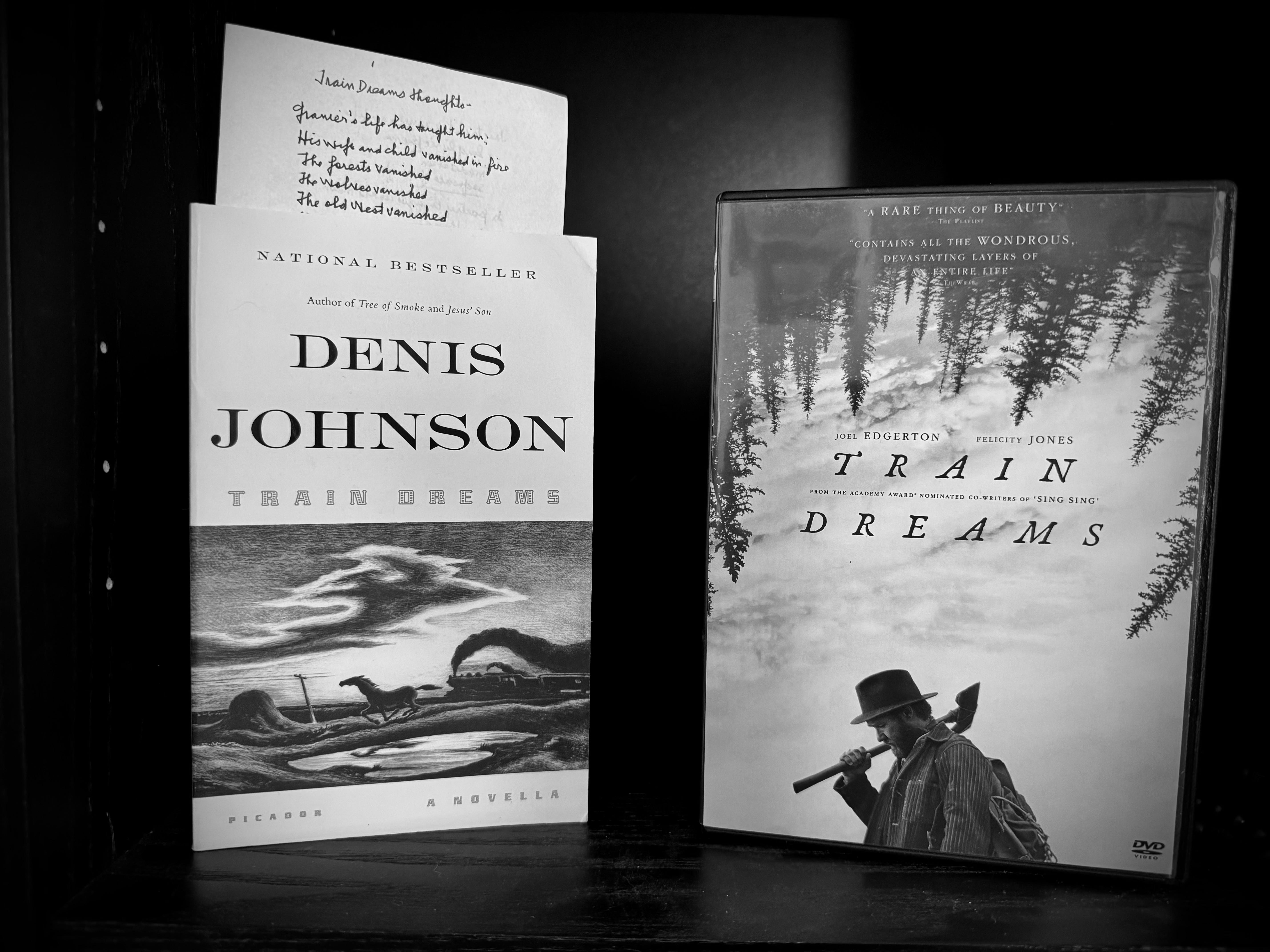
This year I watched the film adaptation of the novella and was deeply moved by it. The cinematography, the acting, the narration by Will Patton, and the poignant end credits song performed by Nick Cave. I loved the movie so much my wife bought the DVD for me. I’ve probably watched it five or six times now.
I asked myself why the novella and movie resonated so deeply. It’s because I feel, like Robert Grainier, like a man who has outlived his era.
I grew up around my father’s vast library of books. I watched my father write legal decisions on long yellow legal pads with his Parker 21 and Waterman fountain pens. On weekends my father sometimes painted in oils, the turpentine wafting through our family room. As a family, my parents, my sister, and I would sit in the living room watching evening television together. It was a shared experience. Not like today, where each family member is lost in an electronic device.
I used to play in the woods after school, on weekends, and during those long summer vacations filled with sunburns, poison oak, deer-trail exploration, treehouse construction, and the feeling that you would live forever. I loved the woods, not unlike Robert Grainier in Train Dreams.
“He liked the grand size of things in the woods, the feeling of being lost and far away, and the sense he had that with so many trees as wardens, no danger could find him.”
― Denis Johnson, Train Dreams
During my teenage years, friends would meet at the shopping mall and then skate Friday and Saturday nights at the indoor Ice Capades Chalet where I eventually got a job as an ice guard. There were no cell phones back then. Just music, conversation, dancing, exercise, and the warm glow of human connection.
My law enforcement career took place in a small town that used to celebrate weekend ice-cream socials in the park, Thursday “Nostalgia Nights” where classic car enthusiasts lined up their restored jalopies to the music of the 1950s, and annual Fourth of July fireworks shows. There were still horses corralled in the rolling meadows behind one of the grade schools.
As a young patrolman on night shift, I’d sometimes park by that meadow and carry a few sliced apples into the field and whistle. Before long I’d hear their hooves, and soon the entire herd was surrounding me as I passed out treats to their soft muzzles.
I know it’s not healthy to live in the past, but I’m not so sure.
There’s a lot there that I miss. Especially the loved ones who are all gone now. But beyond that, it’s the era I miss. It felt like we were more connected then, connected to one another, to our work, to our passions.
Now it often feels shallow, distracted, and foreign.
I was recently in San Francisco with my wife.
We visited my grandfather’s grave at the Presidio, met some wonderful old friends for dinner, and spent a little time exploring Chinatown. My father used to work in the city, and so it holds a special place for me. So many memories.
I brought my trusty rangefinder camera to take some street photos.
As I meandered from one street to another I heard the mournful, almost human-like sound of a Chinese violin known as an erhu. Rounding a corner, I saw an elderly Chinese gentleman seated by the curb, eyes closed beneath the brim of his sunhat, skillfully playing the instrument.
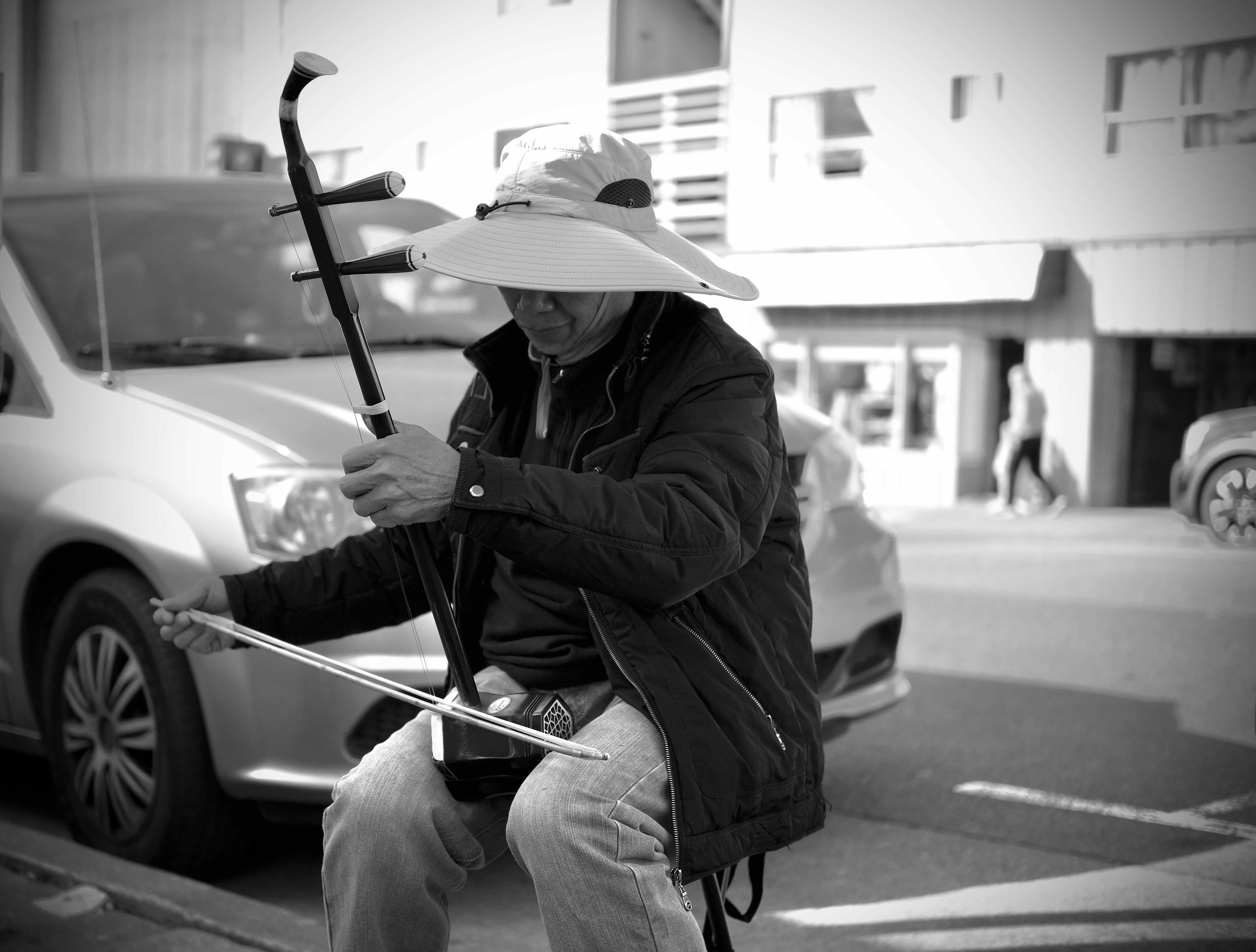
He looked like a man out of time. A man from a different era.
I imagine the world is vastly different for him, too. And yet there he was, sharing something beautiful and enduring with today’s world.
I fished some cash from my wallet and placed it in the little tip box in front of him. He looked up at me with an appreciative nod. I held up my camera, looked at it and then back at him, and he nodded again.
I’m glad I took the photo, because that moment opened a sliver of grace in my melancholy heart.
I suspect we all, if we’re blessed with a long life, arrive at this vertiginous place in time. Where we feel a bit lost and far away.
We miss the people and places and events that defined our era, yet here we are in this new generation of rapidly evolving technology and cultural change. And so we must figure out how to navigate unfamiliar terrain.
I have a novel in mind.
I’ve been sketching out ideas and notes and themes. Loosely, it will be about an aging cop who is still on the job but growing in despair. He doesn’t like where the world is today. He sees the erosion of institutions. The decline in standards. The societal narcissism and growing purposelessness afflicting the culture.
But amidst the crime and loss and despair, he still sees moments of grace.
Instances of people being kind. Neighbors being thoughtful. Business owners helping the less fortunate.
And he arrives at a thought. A mantra. Maybe even a prayer:
“Posts change, the watch remains.”
The line was inspired by the pragmatic “do your duty” philosophy modeled by my father and various mentors during my police career. But it is also inspired by the most austere and cloistered monks in the Catholic Church, the Carthusians.
They live in cells and speak only during the offices of Mass or during a once-a-week nature walk. The Carthusian order was founded in 1084 by Saint Bruno of Cologne. Bruno and six companions established the first monastery, the Grande Chartreuse, in the French Alps near Grenoble, to lead a life combining strict solitude and communal prayer.
The Carthusians have a motto, Stat crux dum volvitur orbis, a Latin phrase meaning “The Cross stands steady while the world turns.”
Their motto represents the contemplative order’s dedication to remaining spiritually anchored in their faith amidst the constant, changing, and chaotic shifts of worldly life.
And so, for an old cop like myself, “Posts change, the watch remains” has become my motto.
It reminds me to remain anchored in the belief that beyond the constant, changing, and chaotic shifts swirling through this modern age, most people are good.
And that we mustn’t give in to romanticizing the past or vilifying the present or wallowing in despair. Where we live, what we do, and who we associate with may change.
So be it.
Each day is a gift. The sun still rises. Birds sing. And whether I’m in San Francisco photographing old musicians or skipping the self-checkout aisle to talk with a grocery store cashier, I carry a quiet thought with me.
My private mantra.
My holy prayer:
“Posts change, the watch remains.”
Before you go
Thousands read this journal each week, but only a few readers choose to support it. If these pages matter to you, you can make a small one-time gift below if you wish.
Thank you for reading.
Subscribe to Weiss Journal.
Visit my Noticings.
John, I was so struck by your piece. I have had similar feelings over the past few days. My first job and most rewarding one was working in historic preservation. Now the city I live in is tearing down older homes left and right. But I fear the multi-families they hope to built will never be occupied by those who need a home; this is a city people want to live in and so they will pay what it costs -- which often put those who can pay first in line. I have also been concerned since I was a child about the environment. Yesterday I was reading about the construction of ICE detention centers and data centers and was prompted to wonder about the people who seem to me to have no moral compass, only a thirst for money or power.
Just over a year ago I returned to the Quaker meeting I belonged to as a student over 40 years ago. There I find people who make up a good community and sometimes the hour of near-silence gives me peace.
I love that your essays are both poignant and hopeful -- they strike just the right balance, and this one was especially beautiful.
If it helps, I'm "only" 38 but I too feel the world has sped up to a point that's hard to keep pace with. Every year there is some unprecedented technology, it seems, and the anxiety and gloom in the general atmosphere seem to worsen. I think it ultimately comes down to the Internet and how it has evolved, iterated and expanded over the decades. It's taken over almost every aspect of our lives.
All that said, I think there are more of us than we realize and who knows, an analogue Renaissance may be in the making. I'm grateful you continue to write.